

When an E-Cigarette Starts to “Burn” – Dry Puff
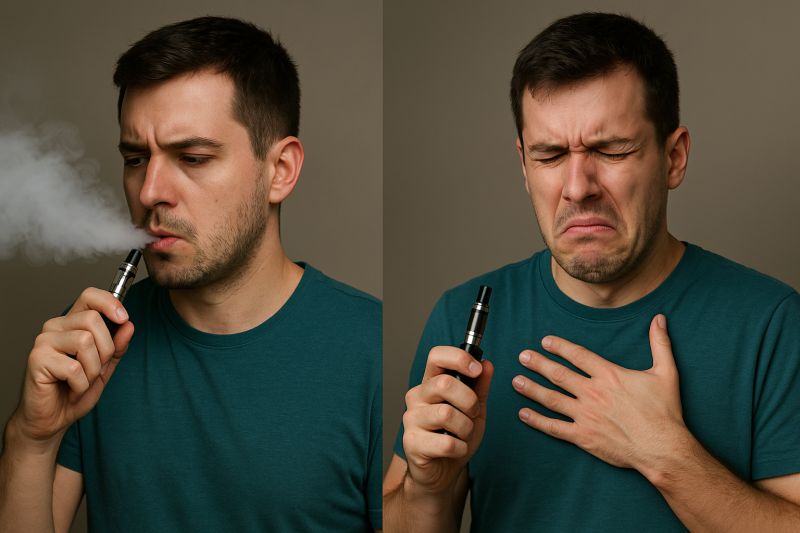
Most people who use e-cigarettes know the feeling: suddenly, a sharp, harsh, burnt taste appears.
It’s not simply “bad e-liquid.”
It’s a dry puff — and it is worth understanding why this phenomenon can be a real safety concern.
What actually happens inside the device?
A dry puff occurs when the heating coil operates at too high a power level or when it is insufficiently saturated with e-liquid.
The e-liquid cannot keep up with the evaporation rate, and instead of controlled evaporation, thermal degradation of the ingredients begins.
As a result, compounds are formed that you do not want to inhale.
Aldehydes and ketones – this is where it gets serious
Research, including Visser W. F. et al., “Improving the Analysis of E-Cigarette Emissions: Detecting Human ‘Dry Puff’ Conditions in a Laboratory as Validated by a Panel of Experienced Vapers” (2021), clearly demonstrated that under dry puff conditions, levels of certain toxic aldehydes can increase by tens or even hundreds of times.
The compounds most commonly detected include:
- formaldehyde,
- acetaldehyde,
- acrolein,
- and other reactive carbonyl compounds.
These compounds include substances with known toxic and carcinogenic properties.
And most importantly — the user can actually detect it.
That characteristic burnt taste is essentially a warning signal.
Why should you react immediately?
Because a dry puff is not simply a “bad puff.”
It is a situation in which the chemical composition of the aerosol can be very different from that produced under normal operating conditions, with substantially higher levels of certain harmful compounds.
If you experience a dry puff:
- stop inhaling,
- allow the coil to become properly saturated,
- check the e-liquid level,
- reduce the power.
The takeaway
Dry puff is not just a matter of taste — it is a clear warning signal.
Ignoring it may mean inhaling compounds that should not be present at elevated levels in the aerosol.